Sometimes the greatest challenge is just where to start.
When the mountain seems so tall, or the ball of twine so tangled. An entire family’s weeks’ worth of laundry…
You get it.
It seems so insurmountable. There are classes and whole areas of business, leadership, and just general problem solving dedicated to this. Don’t let the grand picture overwhelm you; look at a few of the parts that seem the most important and just chip away at them. One at a time.
Figuring out where to start has been my greatest enemy. I have literally paid for this damn domain for three years and have produced zero posts. None. I didn’t even start styling my page until this past July. The reasons are understandable, and when it comes to life as a 46-year-old father of two sons, having a loving wife who works full-time, and a growing array of animals, prioritizing writing for the sake of writing when it’s not a source of income seems somewhat pointless. It feels even more pointless in a space where blogs, podcasts, Substacks, X feeds, and your gamut of social media sites provide enough words, information, vitriol, and opinions that it begs me to ask the question: “who fucking cares?” Why would anyone want to listen to me when we’re in a room of people talking to each other, but no one is really listening? Who am I to add to this noise? Who am I as a person? We can talk about that another day.
I’ve always been an oversharer of personal details. I think it’s common these days, and many would claim it’s a sign of narcissism, self-indulgence, or someone who’s begging for attention. I’m not going to argue with many of those claims against me, but the need for attention is spot on. Sharing personal details with strangers or people outside your close inner circle isn’t inherently any more self-indulgent or narcissistic than a hundred other ways we seek attention, validation, or connection. That’s just my take on it. I don’t like being in the spotlight, per se, but I do crave a certain amount of attention. It’s actually become a survival mechanism for me, but let’s not get too far ahead of ourselves here.
I don’t really want to sit here and lay out all of these details in some sort of sob story, but it’s good to have a little bit of context to understand where we’re going on this grand adventure. Trauma and depression have some tricky bits when it comes to making you feel like you need to minimize the seriousness or even brush off the effects that events can have in your life. A sort of “PTSD imposter syndrome”, if you will. We’re inundated with crazy shit in the age of the internet, and the amount of bonkers/WTF news that comes at you is next level. Trauma is almost a passé word. Maybe watered-down is a better description. We all have trauma, right? These days we could call it “six degrees of mass casualty”. Surely someone you know has been a victim of, involved with, witnessed or been affected by something like this.
I spent almost four years working at a level I trauma center in Milwaukee (I’ll let you guess where you smarty-pants- there’s only one…) as a CNA during nursing school and then a nurse. I worked on the floor dubbed “2NT.” That’s just hospital speak for “2-North Tower.” It was a 32-bed trauma-surgical floor where a team of doctors, surgeons, and advanced practice providers were on staff 24/7. Picture a medical-surgical floor somewhere between the Emergency Department and the Intensive Care Unit. Patients were either straight from the ED trauma bay to surgery, then to us, or ED to surgery to ICU, then to us. It was the craziest place I’ve ever worked, and I loved it. I was great at it.
Obviously I am not going to share specifics for the sake of privacy, but we saw some of the craziest stuff, and it was like a revolving door of “holy shit”. If you think the show The Pitt has some gnarly stuff, it’s kind of tame compared to the real thing. They nail some of the craziness that goes down in big city hospitals, but the cases aren’t even close. Think every manner of car/motorcycle accident you can. Severed limbs and torsos. Skin getting ripped off (the medical term is “degloving”), or being impaled by trees, industrial equipment, attempted suicides, and wounds so big you could put your head in them. Sorry. I’m getting carried away. Another claim to fame is what we would term as a “TBI” or traumatic brain injury.
I was really good at helping this patient population. I didn’t connect the dots at the time, but my older brother Joey had a severe brain injury. His accident was much different and came from prolonged hypoxia during surgery. The ET tube was not placed correctly, and his brain was not getting sufficient oxygen for a long time; he suffered severe brain damage that left him quadriplegic, non-verbal, and completely dependent on care. This happened in 1980, the year I was born, so I didn’t really know him any other way, but I’m sure that those 23 years (he died in 2003) living with him and around people who took care of him exposed me to some experiences that made it easier for me to work with. My buddy even dubbed me the “TBI whisperer.”
I loved the chaos of 2NT. It was a special kind of messed up. The stories we shared, the people we met, worked with, and took care of are almost impossible to understand until you’ve lived it. Not dissimilar to vets who’ve seen “the shit,” or how Viktor Frankl describes emotions and stories shared in concentration camps in Man’s Search for Meaning. I’m not comparing, but the point remains that there are certain places, professions and experiences that just cannot be shared or understood without experiencing them.
The problem was that I didn’t have a way to cope with it. Some people could let it go. Some people could turn it off and go home with their families or friends, and while it took its toll on them, they were “fine.” Or maybe they just seemed that way. That’s another layer of problem. Nursing school. Healthcare organizations. Even law enforcement and first responders don’t always have the resources they need to “process” these experiences. Sure, you can use the employee assistance programs, or nurse mentor programs, or even just go to talk therapy, but it’s always just surface level. The real coping happened when we went out together. Not just at bars but just being in spaces with people who “get it.” Working nights, we’d go to third shift bars on Monday morning after our third 12-hour shift on Sunday night (three 12s was standard, four 12s was self-torture), and half the bar was industrial workers, and the other half was ED, ICU, and trauma. It’s good to have connections with people who can share your understanding. Trauma bonding is not the right word in this context; shared trauma camaraderie. We didn’t just talk about how fucked up our shift was, but we got to complain about bosses, shitty workers, the downfall of healthcare and society. We also got to talk about our families and our lives and be grateful for what we had after treating people who had lost so much or were teetering on the fence of life and death. I didn’t deal with death a lot at that job, but it was an ever-looming dementor, waiting to descend upon me and feed on my happiness.
Alcohol was surely needed…until it wasn’t. It was hard to go home and just turn it off, so I had some beers. I wasn’t drinking crazy by any means, but it was always a thorn in my side. Like a splinter that just wouldn’t come out but would still just hurt enough to need tending to. If I wasn’t waiting for an opportunity to drink, I was thinking about it. I wasn’t hiding it really, but I wasn’t forthright about my relationship with alcohol with anyone, except maybe some close nursing friends. Even going to bars with other nurses was only helpful to a certain extent. It’s easy to talk yourself out of being happy with co-workers. Rumination and complaints were common. Not to mention, you’re not really experiencing or processing emotions while drinking. Even if it’s just a couple, it’s a way to numb. And I was really good at numbing. So good that the splinter that I was medicating had likely been there for years…decades. It was infected and spreading, like an abscessed wound festering with pus.
Fun Fact: The word rumination comes from Latin and roughly translates to “chewing the cud.” Ruminants are animals that chew cud. Think cows. Cows have a stomach with four compartments; they chew and swallow grass, then regurgitate it and chew it again and again and again…It’s what we do with our thoughts. We have negative things (usually) to say in our heads, and then we chew it and swallow it, and then we bring it back up again, and then we swallow it again. You get it. We ruminate on our thoughts, and it’s like being stuck in a place in time. Did you ever do or say something stupid, and you couldn’t let it go? You replay it over and over and constantly beat yourself up or get yourself worked up or anxious. I can think of conversations I had 20 years ago that can make me want to bury myself. Think about that. A thought or memory that likely only you remember has the power to make you go from happy to sad, to angry, to having a full-blown panic attack. Your body has a physiological response as if being threatened by the possibility of harm or even death, all while sitting on your sofa. That’s where we’re at in evolution, eh?
Anywho. After a year on the floor, I got burnt out. I didn’t feel like I was doing a good job anywhere. At work and at home, and I was dreading going to either. There were some specific things that happened (COVID being one of them) with being a nurse that also played into that, but I’m getting long-winded here and don’t want to digress too much.
I transferred to the Operating Room, and lo and behold, I loved that and was good at it too. Surgery was a very different beast, but it played to my strengths. It takes a lot of training and time to even be able to run a room and know what you’re doing. They have a six-month orientation period, and it was two weeks of training before we even stepped foot into an actual room. So, the first day we go into a room to do a “walk-through” of a surgery day but it just happened to be in the trauma OR. The trauma room is always set up just in case but not actively used unless a trauma is called. Many days it sits empty, just waiting for a poor, unfortunate soul to be brought in and saved. So here we are talking through a hypothetical case with the educator, and sure enough, a trauma gets called. “Wouldn’t it be good to just sit here and be a fly on the wall?,” she says. Of course! Who wouldn’t want to see a trauma come through to understand how urgent or emergent cases go to see how that is? The trauma in question required something termed “mass-transfusion protocol”. It basically means send as many bags of blood as you can until we tell you to stop. Oh, and we’re going to try to infuse it as fast as we can to make sure the patient doesn’t bleed out. Trauma surgeons and residents don’t know you’re training or that you haven’t even started actual orientation. They just see the shiny RN badge and start yelling at you to do shit, so you do it. I’m not going to say, “I don’t know how.” I’m going to say sure and then ask someone nicer what to do.
Twenty-four bags of blood. That’s how many we double verified and handed to the anesthesiologist before the patient died. Death is not common in the OR. Usually, they will try to get the patient as stable as possible, and then if it’s not a good-looking prognosis, they send them to the ICU where they might die instead. Morbid health care humor…
After a little over a year in the OR, I had the opportunity to transfer again. I still wasn’t sure what I wanted to do as an RN. My original goal was to be a nurse practitioner, but I wasn’t so sure after watching them work at the hospital. The shifts were better, and I was able to be with my family more, but I was still trying to find my calling. Not to mention I was still drinking expensive beers, and I was always buying stupid shit to try to make myself happy. Even if it was for training, bikes, running gear, expensive gadgets, and video games, I was always looking to claw my way out of the holes I was digging. I transferred to a remote RN job in October of ’21. I was so excited to be able to work and do all the things I wanted to do to be active and healthy. I was going to get up and exercise and meditate. I started coaching hockey and finding all the health and wellness podcasts to help execute my vision for greatness.
November of ’21, for whatever reason, I got us a table reservation street-side on Main St. in Waukesha for the Christmas parade. We went once before and handed out candy for our church, but it wasn’t like a thing that we always did. It was cold-ish, and I had a beer league hockey game that night, so I was refraining from the social lubricant until after my game. I took a picture of Walter and Henry overlooking the street as the parade went by and it was a decent time.
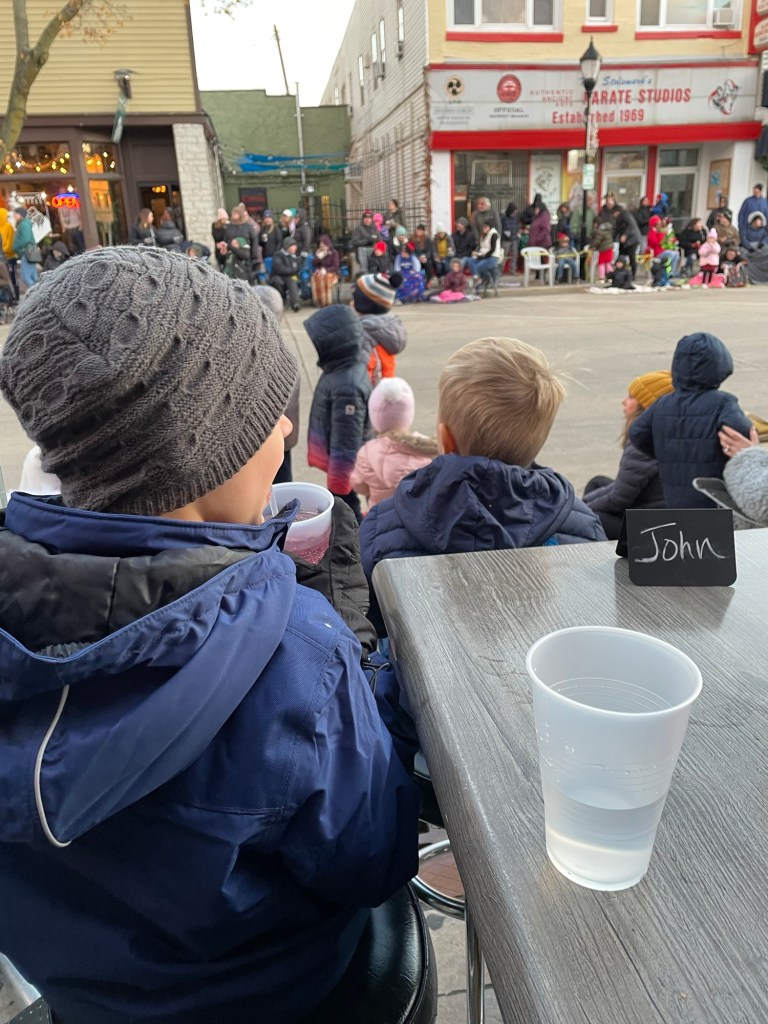
Within 15 minutes of that picture, a red SUV came barreling down the road. I remember the sound of the engine revving really high, punctuated with the impact of the car on every single human body on the road. The sound of that impact is something that I can neither describe nor forget. It was almost as if that sound was shaking through my soul. As if an unknown terror had crept in and had possessed me and my family, and the trajectory of our life was radically altered to the point of unrecognizable fear and ever-present danger, disguised as our need to appear happy even when we’re not. It set off a cascade of events that I would have never predicted, and if I did have the foresight into their existence, there is a chance I would have told you I quit right there. The scariest part was the fact that my splinter had grown and was now shaken loose. As if it had been infected but lay dormant, latent like a virus hiding in your cells, waiting for the opportunity to proliferate and spread. Prior to this, I was able to fight off the infection through staying busy at work and home, and the altruism of being a nurse in the hospital. Now I was listening to people argue about bureaucracy, KPIs, and how to get out of work as much as possible. And I was doing it alone at home, and the beer in the fridge was right there….
I jumped straight into the road to help. I did CPR on most of the Dancing Grannies. I don’t even remember looking back for my family. I knew that they were ok, but it haunted me for a long time that it was at least 30 minutes before I learned where they were. It seemed like hours. The sun had set on the love of Christmas for us that night, and it was just plain cold out. Those dementors that were looming had descended and were taking people’s souls, and I was trying to save the victims even though many of us knew it wasn’t going to work. There are times that I wished they took me with them too, away from the cold. I was numb, but alert. Lost, but vigilant. I knew what to do on the street amidst the chaos, but I didn’t know how I was going to live life at home the next day, and the day after that. Black Friday, we lost another life in our unborn child. The next May, I lost one of my best friends to cancer. That August, Bethany nearly died from anaphylactic shock due to a bee sting. I couldn’t save her myself, but I knew enough to call the paramedics. The good news was I quit drinking, but we lost a few more pregnancies before we decided we were done trying. January of ’25, we lost Bethany’s brother Andy to suicide.
November of 2025, I thought I had all but worked out my devils when it came to the parade and the aftermath of life that wrought havoc on my nervous system. We hosted Thanksgiving at our house as usual, but it was the first without Andy. Christmas had already had a different tone since the parade, but this one was harder still. New Year’s came with a renewed sense of longing for health and happiness, but once January 8th (the anniversary of his death) rolled around, we were all at the mercy of life. Although I knew that I had no option but to live, I wished for death. I never had the intention to kill myself, but the thoughts were so strong to just be done with it all. I told people openly, and it terrified them. I was near psychotic from overusing my stimulant medication to function, and yet I was barely able to do my job. I lied to look like I was happy and somewhat functioning, but I existed in fragments. Scattered in moods of extreme highs and lows. I was experiencing separation from any real connection with who I actually was and how I was going to survive this and keep my family together. Every week seemed like it was its own lifetime, and I was a skipping record of trauma and sadness. Desperation and despair. I was stuck in time and looking for any means of self-destruction disguised as self-help.
To say I wanted out and was praying for mercy is an understatement; God gave me mercy and a blessing even though I didn’t deserve it. Sure enough, I had realized that even though death was forming everywhere, I was being offered a blessing the whole time, and telling God, “No thank you.” Once I realized that it wasn’t my job to fix everything, I was admitted to Rogers Behavioral Health in their partial hospitalization program for PTSD/mental health and addiction.
And that is where my story truly begins…


Leave a Reply