I promise that every post will not be so heavy. My life and my family’s lives are not all doom and gloom. Quite the contrary. Therein lies the paradox. How can someone with so many blessings, surrounded by loved ones, feel so broken at times? That’s one of the great lies that trauma and depression can propagate. To look at something “dialectically” (referring specifically to dialectical behavioral therapy/DBT) is to know that two opposing things can be true at the same time…and it’s ok.
Starting at Rogers was exciting. PHP, or “Partial Hospitalization Program,” is essentially a full, six-hour day of group therapy five days a week. Intensive Outpatient, or IOP, is half that time, five days a week. Schedules can vary, and programs at different facilities can be structured very differently based on the patient population’s needs. Still, for the most part, you are voluntarily going to outpatient therapy for several hours a day over several days and weeks, vs. Individual therapy.
I wanted to get away from my job. It wasn’t the work, or working from home, that was making it so challenging, but the ability to avoid my feelings and emotions related to everyday life was so overwhelming that I was experiencing panic attacks and being so manic and reactive that during work hours was the rare time that I could turn off the dogs barking in my nervous system.
After a few weeks of trauma skills class and learning about dialectics and schemas, I wasn’t sure where/how this was going to go or what it would look like. Everyone starts on different schedules, so people came and went frequently, since many people in our groups had started before me and were finishing up. After sharing some details about the things I had experienced recently and was struggling to figure out how to process them, one of the trauma social workers pulled me out of a class to ask me if I was interested in the written exposure group. I had begun writing more at home and was always looking for a way to practice my skills and share my experiences on paper. After answering some questions and spending some time discussing what the group is about and how it operates, we decided that I would transition to IOP (half days) and start the written exposure therapy (WET) on an upcoming Monday. Tuesdays and Thursdays were writing days. Mondays were “schema” days, and Wednesdays and Fridays were processing days. On writing days, we spent thirty minutes writing from a prompt given by the trauma therapists, followed by a grounding activity. We rated our distress level before and after writing, and the purpose of grounding was to allow people to use their senses to return to the room and leave the world of trauma that they were writing about behind. The goal of WET is to go back and write about the traumatic experience(s) in great detail. With the guidance of the therapists and the group, you would work to reduce the physiological response to those traumatic memories. Using the skills we learned and how they played into our schemas, we were able to understand and process our emotions so we could move beyond those moments frozen in time and see how our core beliefs about ourselves could drive behavior that didn’t align with our values. This tension, or friction, can often cause other problematic coping mechanisms.
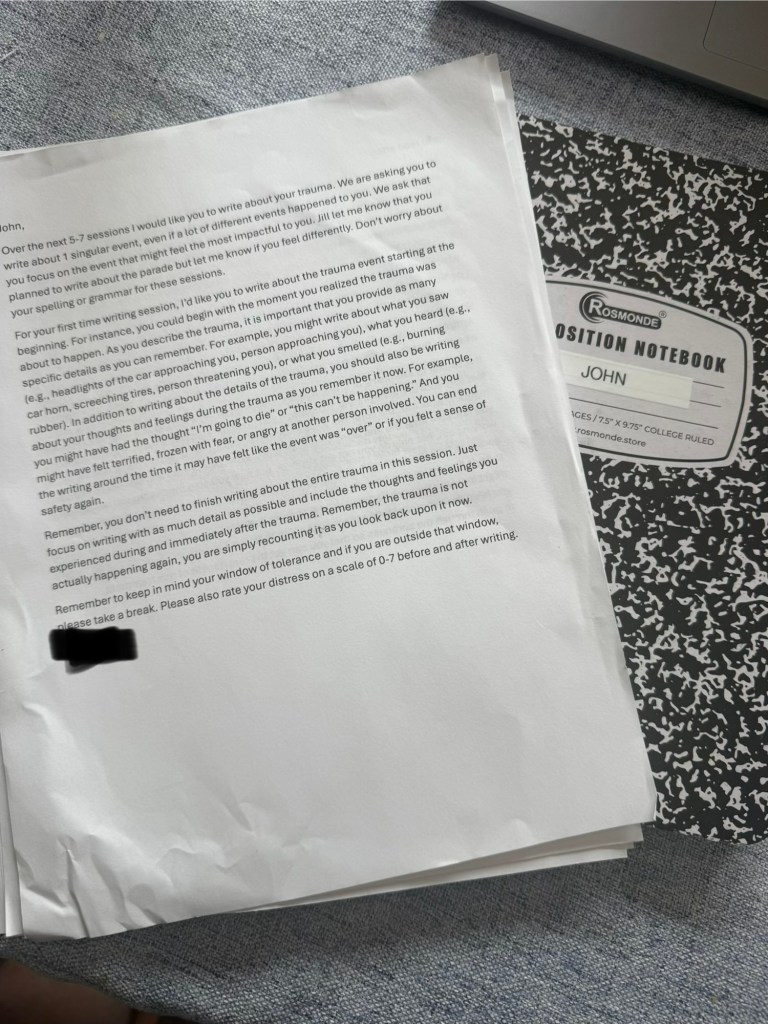
The social worker warned me that I would be the only male in this classroom. It wasn’t uncommon for these groups to be predominantly female, but in this case, I was the only one. I didn’t really think this was something I needed to worry about. When I walked into the room, the previous class was finishing, and I awkwardly looked for a seat, feeling shy and out of place. I could tell right away that I was oil in water. “I think you’re in the wrong room,” was the first greeting I met with. I politely tried to explain that I was new/joining the group. I tried to keep an open mind and not come from a place of judgment of anyone I met or talked with. One practice that is very important in any behavioral treatment (or life, for that matter) is a sort of radical acceptance. Everyone’s shit stinks, right? Everyone here (again, and in life) has a story. Situations and experiences that have taught them to think and behave to navigate the world. Let’s not forget that everyone here is fighting some spiritual battle for their own soul and freedom. We judge the behavior, not the person.
Most of the people I was in the group with were there for very different reasons and experiences. We came from different socio-economic backgrounds, races, and age groups. Many were learning to understand how to process sexual trauma, rape, and sexual assault. Some had been exposed to sex trafficking, abusive parents, violence in the workplace, and workplace-related trauma. This is where that PTSD impostor syndrome really kicks in. “How can I sit here and complain about my experiences? These are real issues from people who are fighting for survival,” I would say to myself. Another quiet mantra to keep in mind is “you never compare your traumas.”
I still hadn’t really started sharing my story or asked to speak during a processing day. I was trying to listen. One of the hardest skills to master is listening. I mean, to really listen…to your body and your values. To listen to others, actively without judging and thinking about what to say. I felt like I had spent the last five years just talking about myself. Everything in depression and trauma is “all about me.” It wasn’t that I was inherently selfish; I was trying to take care of my family, and I was struggling to really take care of myself. Don’t compare your traumas; living the way many of us do is survival in and of itself.
We had already settled on the idea that I was the only male in the room, and I had made some closer friendships as I began to learn how to write and navigate this group. After writing, we don’t really talk about the content itself. We mostly describe the experience of writing and what sort of body sensations or feelings arose when you were writing. We try to nail down the details of our senses and emotions, and whether we were able to handle it, or if we had certain needs from the therapists or the group itself. It’s also not uncommon to feel a “kinship” with other people you’ve met through shared vulnerability and by finding friends you could identify with. We would use ice packs to help calm (it’s called the dive reflex-go dip your face in ice-cold water, and it will lower your heart rate and calm you down), or people would do art or find other ways to soothe emotional reactions to re-living these stories in great detail. A quieter woman I sat next to decided she wanted to speak for a processing day after doing some writing.
What she shared was a story that struck me with awe at a world I could never imagine. We understand crime and poverty, but we don’t always really understand the why. Growing up as a young girl in the city, whose parents were addicted to drugs, left her and other siblings to take care of themselves. The parents too grew up in a violent, often abusive home, rife with abandonment. I couldn’t help but listen and feel a sense of sadness and utter amazement at what a child, who didn’t really have any choice in where they were born and where they grew up, how they looked, and what class system they fell into, just had to figure out how to survive.
She told us the story of what seems like sheer nightmare fuel to most people I knew: having to learn on her own how to survive with crime and theft. It helps you understand why you shouldn’t really judge someone, especially without knowing the details…all the little moments, the stories that make people who they are. We all have one. Every human learns to fight for survival one way or another. At one point she decided that was enough. It’s not as if you can say “goodbye” from a life like that. She carried so much shame and fear. She coped in ways she learned over time.
I couldn’t help but feel awe at her courage. Courage to tell the story. Courage to grow up and survive in every sense of the word. Courage to decide to alter her life…and accept the responsibility of her choices to come to this place to learn how to manage those demons for herself.
Me being me, I like to recite nonsense like a 25-cent Ted Lasso, hooked on podcasts and regurgitating every profound mixture of words he can consume. Terry Real has one of my favorite quotes that I shared with her: “Family dysfunction rolls down from generation to generation, like a fire in the woods, taking down everything in its path until one person in one generation has the courage to turn and face the flames. That person brings peace to their ancestors and spares the children that follow.”
This is not a real photo
She had the courage. Many of us do, and we don’t give ourselves credit.
When I finally decided it was time to share my story, it was easiest to start with the parade, but it usually devolves into more about Joe and my childhood, and how his injury affected our family. This is where schemas come in. Schemas are core memories/experiences formed in childhood (and in trauma) that can form how we view and cope with the world. Important survival mechanisms can become harmful as adults…and remember, schemas can explain our reactions, but they don’t excuse harmful behavior, cuz you know what they say about excuses?
- “Excuses are like buttholes, we all got ’em, and they stink.” -I’ll give credit to Jeff Lovecchio on this one.
The thing I learned most in a place like this was total vulnerability. Most of the time, I had to hide away from the things that made me feel bad about myself. As the esteemed Dr. Alok Kanohjia (Dr.K, or “HealthGamerGG”) asks (paraphrase), “Will it make you feel content with who you are, or will it fill you with regret?” It’s what helped me feel more content with who I was. That’s what was hard. I was good to other people, but I was such a terrible jerk to myself. Do you ever write down the things you say to yourself? Would you say it to a child? Would you say it to yourself as a child?
My survival mechanisms were always there, but added in a healthy dose of trauma, and a smoldering bonfire grew out of control and burned everything down in its wake.
The woman whose story touched me so profoundly, whose world seemed so much more distant and violent than mine, looked at me and said: “I can identify with how you feel about yourself.” As we talked more, we realized we were really the same thing. Humans with souls who needed to understand why they felt so heavy, even in the face of being blessed with so many people and loved ones and friends who cared enough to tell us to take care of ourselves. To learn…to RE-learn how to love ourselves. I can give everyone unconditional love, even at the cost of myself, but I couldn’t give it to myself.
One of the greatest compliments I received from some of the women in that group was that they worried my arrival would change the group’s vibe. That having a male would make the feeling and ability to speak in a certain way, along with the form in which the conversation took place, seem altered due to no known fault of anybody’s. But because I could be honest and vulnerable about myself, it didn’t change. In fact, they told me that it was better because of it. I was able to help them shed aspects of their schemas and core beliefs about men and how men spoke about and shared their mental health.
My being vulnerable helped me just as much as it helped them.



Leave a Reply